
Resources
Access real-world insights, XCOPRI patient stories, and downloadable tools to help your
patients and practice.
Access real-world insights, XCOPRI patient stories, and downloadable tools to help your
patients and practice.
Expert insights
Hear from your peers who have switched on XCOPRI—and are seeing meaningful results.
Treatment impact

Trust in efficacy
Michael Smith, MD, speaks to his growing trust in the efficacy of XCOPRI—and why his patients appreciate getting to monotherapy after often having been on many medications in their lifetime.
Clinical dialogue: Achieving zero seizures with XCOPRI
In this clinical dialogue, Raman Sankar, MD, PhD, and Christopher Elder, MD, dig in to what it takes to achieve zero seizures. They review clinical trial data for XCOPRI, as well as a real-world case involving a 36-year-old man with drug-resistant epilepsy who achieved zero seizures on XCOPRI.
The XCOPRI impact
Lawrence Seiden, MD, discusses one patient’s journey with XCOPRI in this compelling case study video. He discusses the path of a patient he’s been treating for over 12 years and how, with XCOPRI, his patient went from having one seizure every 4 to 6 weeks—to almost zero.

The possibility of zero seizures
Pavel Klein, MB BChir, FAAN, FAES, discusses the impact of XCOPRI on his patients whose lives have been taken over by seizures.
Starting and keeping your patients on XCOPRI
Prescribing XCOPRI in practice: A tailored approach
Michael A.L. Johnson, MD, FAAN, shows how a tailored approach when initiating XCOPRI can shape long-term outcomes. He shares the case of a 50-year-old woman who was battling breakthrough seizures until individualized management during titration helped her achieve a reduction to 1 seizure in 12 months.

A chance to reach zero
In this powerful case study video, Pavel Klein, MB BChir, FAAN, FAES, discusses one patient’s journey with XCOPRI. Dr Klein also covers his decision making in adding XCOPRI to the patient’s treatment regimen as adjunctive therapy, as well as his considerations regarding dosage adjustments.
Optimizing long-term epilepsy treatment with XCOPRI
Steve Chung, MD, unpacks how to build a lasting treatment strategy for adult patients with epilepsy in this video. He walks through patient- and disease-specific factors that shape his approach and explains why long-term retention can help keep the goal of zero seizures within reach.
A long-term treatment journey with XCOPRI
Steve Chung, MD, shares a compelling case study. After years of recurrent seizures despite multiple prior therapies, a 55-year-old man has now been seizure-free for over a year and a half.
Illuminating the path for Over 325,000 Patients and counting*
Watch real patients shine a light on their journey with XCOPRI
Hover over each patient to learn more, then click to expand their full story.

Real XCOPRI patient stories
Illuminating the path for Over 325,000 Patients*

Shannon, finding his support network
Before XCOPRI: 1 seizure/month; 2 ASMs
After starting XCOPRI: seizure-free for the past 5 years; XCOPRI 100 mg + 1 ASM
Follow Shannon as he navigates the unknowns of epilepsy, and hear how reducing his seizures helped him reclaim his life.
“Don’t be afraid to ask. Don’t be afraid to try a different medication because XCOPRI thankfully worked for me.”
After an accident led to his epilepsy diagnosis in his mid-30s, Shannon struggled with embarrassment—especially when seizures happened at work or in front of his children.
Since achieving seizure freedom after starting XCOPRI, Shannon has reclaimed his independence. He is back to his job as an airport terminal superintendent and enjoying cherished date nights with his daughters.

Laura, not giving up after diagnosis
Before XCOPRI: 1-2 seizures/month; 5 ASMs
After starting XCOPRI: significant reduction in seizures over the past 2 years; XCOPRI 100 mg + 1 ASM
Laura shares her experience of being diagnosed with epilepsy later in life and how she found the courage to keep moving forward.
“I want to let people know there is life after being diagnosed with epilepsy.”
Laura first started having nocturnal seizures at 57 years old. After diagnosis, she was forced into early retirement and feared epilepsy would prevent her from the vibrant social life she loved.
Since achieving a significant reduction in seizures with XCOPRI, Laura is getting back to what matters most: her family, sports games, and rock and roll.


Natalie, re-energized to support her community
Before XCOPRI: 3 seizures/month; 2 ASMs
After starting XCOPRI: occasional auras but no tonic-clonic seizures in 2 years; XCOPRI 300 mg + 1 ASM
Watch Natalie share her journey toward seizure freedom and how reducing her seizure activity has renewed her energy to enjoy life.
“Being around others, and hearing their stories…it’s an amazing feeling.”
Natalie has been living with epilepsy for over 40 years. Like many others with this disease, she is all too aware of the potentially devastating impact that just one seizure can have.
Over the past 2 years, she has experienced occasional auras but no tonic-clonic seizures. Now, she feels empowered once again to enjoy her life and engage with others in the epilepsy community.


Koral, a teacher and advocate
Before XCOPRI: daily seizures; 4 ASMs
After starting XCOPRI: 1 seizure every 3 months; XCOPRI 200 mg + 3 ASMs
Learn how Koral’s determination helped her regain a sense of control in pursuit of the possibility of zero seizures.
“With those reductions, I feel like I’m in charge of my life again. Don’t ever settle for anything less than you deserve.”
Koral started having seizures in high school and spent years undiagnosed, battling multiple seizures a day while trying to keep up a normal teenage life.
Since starting XCOPRI, her seizure frequency has dramatically decreased. Today, Koral is back in college and continuing to pursue her passion as a teacher for children with autism.


JenVon, empowered to help others with epilepsy
Before XCOPRI: 3-4 seizures/month; 10 ASMs
After starting XCOPRI: significant reduction in seizures since beginning treatment; XCOPRI 100 mg + 1 ASM
JenVon discusses the importance of speaking up for herself and how it’s helped her become an advocate for others.
“I hope I can inspire someone in my situation. I would really give [advice to] anyone going through this journey or newly diagnosed that life is possible.”
JenVon was diagnosed at a young age and spent decades navigating epilepsy before finding XCOPRI.
At first, she was hesitant to try yet another medication. After 2 years on XCOPRI, JenVon continues to see significant reduction in seizures. Achieving more control over her seizures has allowed her to find the confidence to speak up for herself and others living with epilepsy.


Paul, fighting for youth with epilepsy
Before XCOPRI: 10 seizures/month; 1 ASM
After starting XCOPRI: 2 seizures/month; XCOPRI 300 mg + 1 ASM
See how Paul kept fighting through years of uncertainty to help ensure others living with epilepsy receive the support they deserve.
“I’m not really going to let epilepsy control me. I want to see what else is out there.”
Diagnosed with epilepsy at just 12 years old, Paul has been living with epilepsy for over 7 years. Paul was experiencing as many as 4 or 5 seizures a day, sometimes during school.
Since starting XCOPRI, Paul has experienced a significant decrease in seizures, which has helped him regain more control over his life. He has since turned to advocacy, helping pass Paul’s Law, which requires schools to provide education on seizure first aid to teachers and aides.
ASM=anti-seizure medication.
Downloadable PDF resources
Our clinical resources and patient support tools are designed to help you make informed decisions, every step of the way.
Switching on XCOPRI Flashcard
This resource highlights important information about prescribing XCOPRI, how to titrate, and drug load reduction.

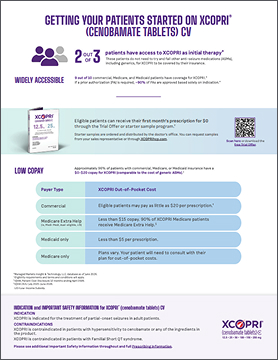
Getting Your Patients Started on XCOPRI Guide
Designed to assist healthcare professional office staff in initiating patients on XCOPRI, this resource provides comprehensive guidance on XCOPRI cost and coverage, prescribing information, and insights into the extensive support programs for both office staff and patients.
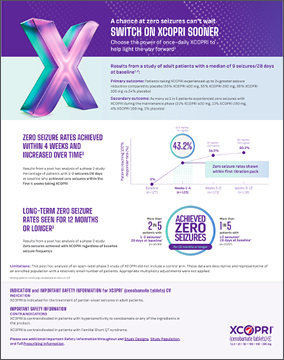
Patient Brochure
This brochure helps your patients understand what to expect from treatment. It includes information on how to take XCOPRI, potential side effects, and a patient-friendly version of the data from the clinical trials.

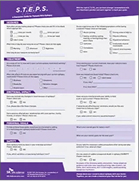
S.T.E.P.S. Discussion Guide
Standing for Seizures, Treatments, Emotional Impact, Personal Goals, and Safety, this discussion guide was designed to help foster a stronger relationship between patients and their care teams and help those affected by epilepsy reach their goals.
The guide is based on a national survey that compiled responses from 400 adult patients, 201 caregivers, and 258 healthcare providers to help better understand the current state of epilepsy in the US.
Next Steps With XCOPRI Brochure
This patient brochure helps new patients understand what to expect when starting XCOPRI, including guidance on filling their XCOPRI prescription, copay information, support programs, potential side effects, and patient testimonials.

Frequently asked questions
Explore answers to common questions about XCOPRI.
The International League Against Epilepsy considers a person to have epilepsy if they meet any of the following conditions1:
- At least 2 unprovoked (or reflex) seizures occurring greater than 24 hours apart
- Diagnosis of an epilepsy syndrome
- One unprovoked (or reflex) seizure and a probability of further seizures similar to the general recurrence risk (at least 60%) after 2 unprovoked seizures, occurring over the next 10 years
A seizure is an abnormal paroxysmal discharge of neurons.2 There are some things that can trigger seizures in patients with epilepsy. They include sleep deprivation, stress, fever, alcohol binging, use of recreational drugs, and use of some prescribed and/or over-the-counter medications.3
Seizures affect people differently, and there are several types of seizures. Seizures may come in 3 distinct phases, with a beginning, middle, and end. Some people experience an aura or other warning signs that a seizure is coming on, including dizziness, headache, nausea, or altered senses or emotions. During the middle of the seizure, some people lose consciousness or feel confused and/or experience tremors or can’t move at all, among many other possible symptoms. At the end, they may feel sleepy, scared, confused, or embarrassed, and/or they may have a headache, nausea, or weakness, to name a few symptoms.4
Most seizures last between 30 seconds and 2 minutes. However, depending on the type of seizure, it can be shorter or substantially longer. A seizure that lasts longer than 5 minutes is a medical emergency.5
Keep the person safe and call for medical help if the seizure continues for a prolonged period of time (longer than 5 minutes). After the seizure is over, stay with them or see them home safely.6
A partial-onset seizure, also known as a focal seizure, starts in one part of the brain and may stay there or may spread. This is different from a generalized seizure, which starts in both hemispheres of the brain at the same time.7
XCOPRI is indicated for the treatment of partial-onset seizures in adult patients, meaning 18 years and older. There are ongoing trials for the pediatric population, but safety and effectiveness in pediatric patients have not been established at this time.8
For additional information, please review the full Prescribing Information for XCOPRI.
Sample packs are available in 12.5 mg (weeks 1-2) and 25 mg (weeks 3-4).
To learn more about receiving samples of XCOPRI, connect with a sales representative. Please fill out a form here.
Patients saw significant reductions in overall seizure frequency during clinical trials, with as many as 1 in 5 patients achieving ZERO SEIZURES during the maintenance phase.8
The top 5 were levetiracetam, lamotrigine, lacosamide, carbamazepine/oxcarbazepine, and topiramate.8-10
Study 2 had a 6-week titration phase and a 12-week maintenance phase. The primary endpoint for each dose included all 18 weeks of treatment. Based on the titration schedule in that study, subjects in the 400 mg group did not reach their target dose of 400 mg until the beginning of the maintenance phase. However, there is a clear dose response (400 mg better than 200 mg) for subjects having a response of 75% to 100% during the maintenance phase.8
A statistical significance in the primary endpoint was demonstrated with 100 mg. Based on the current recommended starting dose and titration, 100 mg is reached at 6 weeks.8
For safety information related to XCOPRI, please see the XCOPRI full Prescribing Information.
XCOPRI should be used with caution, and dosage reduction may be considered in patients with mild to moderate (CLcr 30 to less than 90 mL/min) and severe (CLcr less than 30 mL/min) renal impairment. Use in patients with end-stage renal disease undergoing dialysis is not recommended.8
See the XCOPRI full Prescribing Information.
For patients with mild to moderate (5-9 points on the Child-Pugh assessment; Class A or B) hepatic impairment, the maximum recommended dosage is 200 mg once daily. XCOPRI is not recommended for use in patients with severe hepatic impairment.8
See the XCOPRI full Prescribing Information.
Familial Short QT syndrome is a life-threatening, inherited heart disease. In an article published in Heart Rhythm journal in 2018, which featured a review of papers published from 2000-2017, there were 220 patients identified with familial QT shortening.11
As per the XCOPRI full Prescribing Information, there is no recommendation to perform an electrocardiogram (EKG) prior to or during XCOPRI use.8
After the Food and Drug Administration (FDA) and Drug Enforcement Administration (DEA) review of the cenobamate New Drug Application (NDA), it was concluded that cenobamate has a relative abuse potential lower than substances in Schedule IV but greater than placebo and should be placed into Schedule V of the Controlled Substances Act.8
XCOPRI is a once-daily pill that is titrated in 2-week intervals and available in 6 tablet strengths.8
See the XCOPRI full Prescribing Information for complete information on how patients should take XCOPRI.
XCOPRI can be prescribed as monotherapy or adjunctive therapy.8
In clinical trials, the top 5 concomitant epilepsy medications used with XCOPRI were levetiracetam, lamotrigine, lacosamide, carbamazepine/oxcarbazepine, and topiramate.8-10
As per the XCOPRI full Prescribing Information, because of the potential for reduced efficacy of oral contraceptives, women should use additional or alternative nonhormonal birth control while taking XCOPRI.8
A list of drug interactions is provided in Section 7.1 of the XCOPRI full Prescribing Information. It is important to be aware of the potential emergence of side effects early in the XCOPRI titration with clobazam, phenytoin, and phenobarbital.8
For additional information, you may contact Medical Information by calling 1-866-657-5574, emailing [email protected], or visiting the Medical Information website by clicking here.
Learn more about prescribing XCOPRI as an adjunctive therapy.
XCOPRI can be purchased at any retail pharmacy.
Nine out of 10 commercial, Medicare, and Medicaid patients have coverage.* If a prior authorization (PA) is required, ~90% of PAs are approved based solely on indication.*
Yes, we have a program called SK Life Science Access+ that may be able to provide financial support to eligible patients. Patients can visit sklsaccess.com or call 1-866-756-2844.
Eligible patients may pay as little as $20 per month for their XCOPRI prescription. Terms, conditions, and eligibility requirements apply.

Access
XCOPRI is widely accessible with low copays. Discover support available to get started
Learn about access
XCOPRI & epilepsy education
See educational offerings tailored for APPs and NPs, from CME/CE-accredited courses to interactive prescriber sessions led by featured experts
Start learning today